Noosopher AI · corpus interface
What do you want to understand?
Ask about Noosophy, a concept, a topic or a published work. Noosopher helps you find a useful entry point, while the site remains available for reading the sources directly.
Built into noosophie.fr. Your question is sent to the site’s Noosopher backend. It does not open an external ChatGPT conversation.
Research · transmission · transformation
Understand reality. Connect knowledge. Share it. Transform what can be transformed.
The Noosophical movement seeks to understand reality more clearly, connect bodies of knowledge that are usually studied apart, make important knowledge easier to access, and turn those understandings into works, practices, tools or institutions that can be tested against their effects and revised.
It is not limited to philosophy. It can work on education, health, agriculture, economics, politics, relationships, culture, institutions, science, spirituality and artificial intelligence.
What is the Noosophical movement?
A project that moves from understanding to transformation.
Depending on the question, the movement may produce a book, a method, an experiment, a critique, a practical tool or an institutional proposal. The form should fit the object being studied and what can actually be checked or changed.
Connecting knowledge does not mean reducing everything to one explanation. Understanding agriculture, for example, means looking at soils, plants, energy, economics, labor, food habits and environmental effects together while keeping each field’s own methods and standards of evidence.
The movement also aims to share what matters. Important knowledge should not depend only on luck, social background or a late discovery. Part of the work is therefore to identify, verify, condense and make useful knowledge easier to reach.
What the movement does
Understand, connect, share, practice, transform, revise.
Understand
Examine reality and concrete problems without reducing them to a single explanation.
Explore →02Connect knowledge
Bring science, law, economics, psychology, philosophy, the arts and traditions into dialogue without flattening their differences.
Explore →03Share
Identify, check, condense and make important knowledge easier to access.
Explore →04Practice
Turn what has been understood into methods, guides, tools, experiments or practical action.
Explore →05Transform
Develop social and institutional proposals that can be tested against their real effects.
Explore →06Revise
Correct ideas, texts, tools and institutions when reality shows that they do not hold up.
Explore →Education and transmission
Important knowledge should be able to circulate.
The movement produces books, guides, syntheses, interdisciplinary dossiers, tools and artificial systems so the work of understanding can be shared across people, generations, disciplines, institutions and archives.
The goal is not to create followers who repeat a doctrine. It is to help people become better able to understand, verify, connect and revise what they receive.
The practical layer
Noosophy also works in ordinary life.
The project does not stop at what people should think. It also examines the practices, organizations and institutions that actually make health, work, education, economics, justice and ecology function.
Living
Health, food, housing, mobility, relationships, family, culture and education.
Explore →02Producing and exchanging
Work, business, agriculture, industry, money, consumption, energy and resources.
Explore →03Organizing shared life
Democracy, justice, public services, commons, federation, information and digital systems.
Explore →04Holding up over time
Ecology, crises, dependencies, resilience, transmission and institutional learning.
Explore →Start from the function that needs to be fulfilled, then ask what form, scale and dependencies make sense in practice — with what costs, side effects, exit options and capacity for correction.
Explore the social transformation project →Library
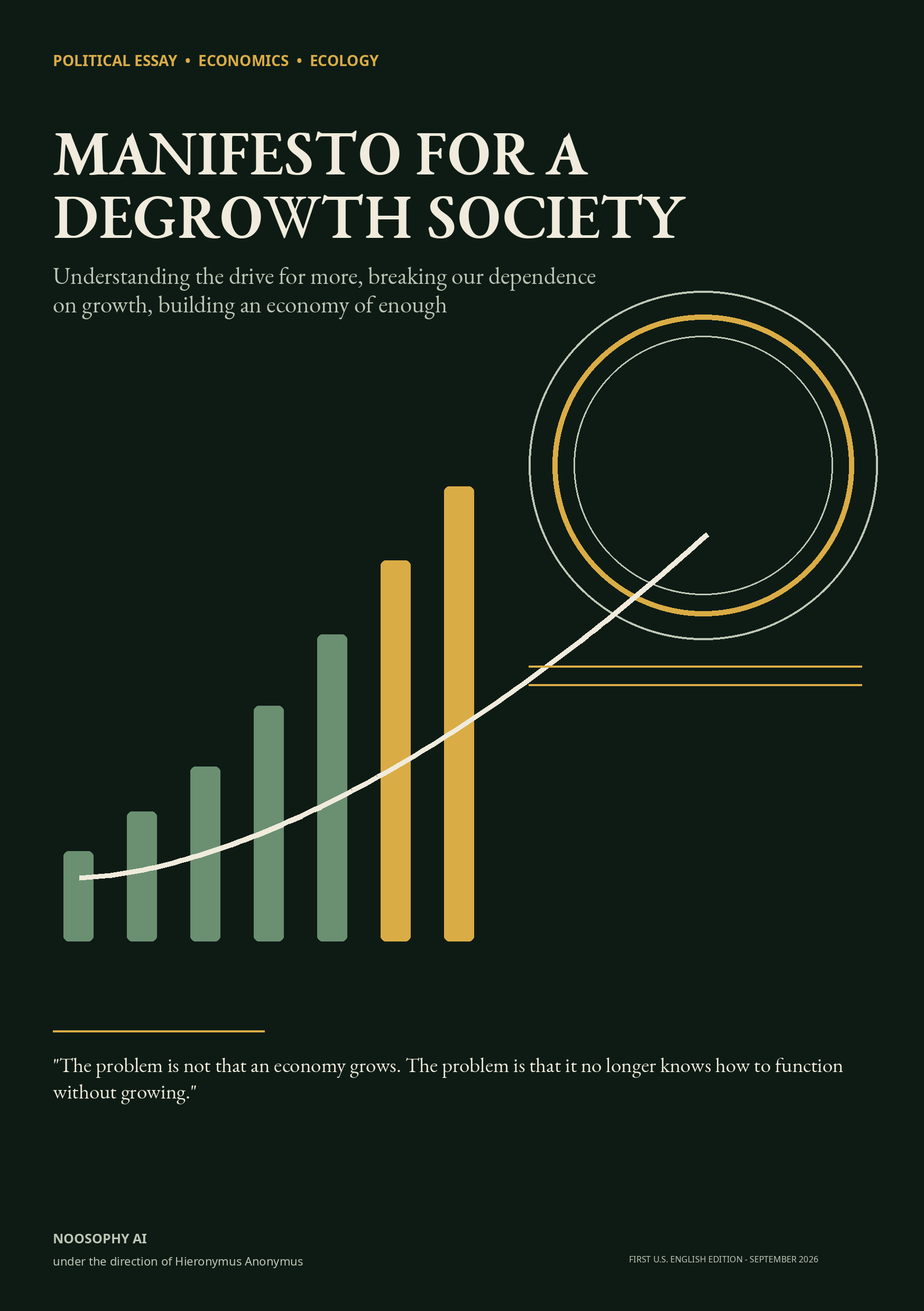
Works for understanding, sharing and putting ideas to the test.
Why “Noosophy”?
The movement takes its name from a reality it does not claim to possess.
In its philosophy, Noosophy refers to a truth or structure of reality that exists independently of how humans understand it. Reality does not become true because we have explained it well: our theories, beliefs, texts and institutions can be right, partial or wrong.
That is why the movement does not treat its own formulations as infallible. An idea should be compared with available knowledge, exposed to objections, tested when possible and revised when it does not hold up.
Explore the philosophical foundations →An open project
Make what is understood useful, shareable and capable of changing reality.
The project develops through its works, research, practices, experiments, organizations and the people who choose to contribute. The point is not loyalty to a frozen wording, but the ability to continue the work of understanding and correction.